Disclosure: some links on this page are affiliate links. If you buy through them we may earn a commission at no extra cost to you. It never changes which products we include or how we rank them. As an Amazon Associate I earn from qualifying purchases. How we handle affiliate links.
In a small office, the best file cabinet is one that rolls under the desk: about 15 to 17 in wide and 24 to 28 in tall, so it clears the underside of a standard 28 to 30 in desk. Measure under your desk before you buy; the drawer or apron is lower than the top.
Below, five cabinets are compared by their listed size, with one honest drawback each. Sizes come from each product's Amazon listing, checked November 29, 2026. We have not tested these cabinets ourselves.
At a glance (Amazon prices as of Nov 29, 2026, 8:33 PM UTC)At a glance
Offices with a free wall and a lot of paper; the top works as a printer or credenza surface
Product prices and availability are accurate as of the date/time indicated and are subject to change. Any price and availability information displayed on Amazon at the time of purchase will apply to the purchase of this product.
Scroll sideways to see every column →
On this page
The picks, in detail
1Best overall
DEVAISE 2-drawer steel file cabinet
Size (W × D)
15 × 17 in(38 × 43 cm)
Height
27 in (69 cm)
Price
$110.49Amazon price as of Nov 29, 2026, 8:33 PM UTC. DetailsProduct prices and availability are accurate as of the date/time indicated and are subject to change. Any price and availability information displayed on Amazon at the time of purchase will apply to the purchase of this product.See current price
Best for: Under a 29 to 30 in desk: letter, legal and A4 hanging files, one lock for both drawers, 330 lb rating, arrives assembled
Drawback: At 27 in tall it will not clear a desk with a low apron or a drawer; measure the gap first
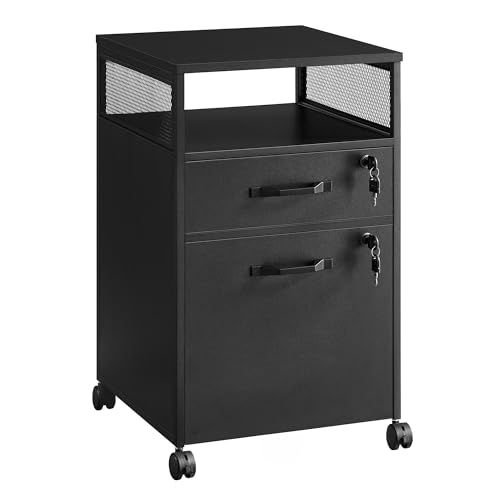
VASAGLE 2-drawer file cabinet with shelf and locks
Size (W × D)
16.5 × 17.3 in(42 × 44 cm)
Height
27.2 in (69 cm)
Price
$67.99Amazon price as of Nov 29, 2026, 8:33 PM UTC. DetailsProduct prices and availability are accurate as of the date/time indicated and are subject to change. Any price and availability information displayed on Amazon at the time of purchase will apply to the purchase of this product.See current price
Best for: Files, supplies and a paper shelf in one footprint, with locks on the drawers
Drawback: Rated for 88 lb in total, far less than the steel cabinets here
$97.74Amazon price as of Nov 29, 2026, 8:33 PM UTC. DetailsProduct prices and availability are accurate as of the date/time indicated and are subject to change. Any price and availability information displayed on Amazon at the time of purchase will apply to the purchase of this product.See current price
Best for: Desks with a low apron or a keyboard tray: 24 in tall, letter, legal and A4, 330 lb rating
Drawback: Shorter means less filing height than a 27 in cabinet; casters go on after delivery
$134.99Amazon price as of Nov 29, 2026, 8:33 PM UTC. DetailsProduct prices and availability are accurate as of the date/time indicated and are subject to change. Any price and availability information displayed on Amazon at the time of purchase will apply to the purchase of this product.See current price
Min room
about 100 sq ft
Best for: Offices with a free wall and a lot of paper; the top works as a printer or credenza surface
Drawback: 35 in wide: it needs its own stretch of wall and about 18 in of clear floor in front to open
Measure from the floor to the lowest point under the desk: the apron, a drawer or a keyboard tray. Most desks are 28 to 30 in high at the top, and the clear height underneath is lower by the thickness of the top and any apron. Subtract about 1 in so the cabinet rolls in on its casters.
2. Check the file size
Files
Drawer must take
Letter only
Letter hanging folders
Letter and legal
Letter and legal hanging bars (often adjustable)
A4 (outside the US)
A4 hanging folders
Check the listing before you buy: some small cabinets take letter and A4 but not legal.
3. Leave room to open the drawers
A drawer needs floor in front of it. RoomSketcher suggests about 23 in in front of a vertical file and 18 in in front of a lateral file. Under the desk, the drawers open into your chair zone, which works because you roll the chair back to use them.
4. Check the weight rating
Full file drawers are heavy. Steel cabinets here are rated for up to 330 lb; particleboard ones for much less. If the cabinet will hold a printer as well as files, check the top’s rating too.
Which cabinet fits which room
Room
Cabinet that fits
Plans
Closet office
None; use a wall shelf or a cabinet beside the closet
To see where a cabinet goes in your room, add a 2-drawer file or a lateral file in the room planner. It warns you when a piece blocks the chair zone or the door.
Frequently asked questions
What size file cabinet fits under a desk?
Most under-desk cabinets are 15 to 17 in wide, 16 to 20 in deep and 24 to 28 in tall. Measure from the floor to the lowest point under your desk, usually the apron or a drawer, and leave about 1 in to roll it in and out.
How much space do I need to open a file drawer?
RoomSketcher suggests about 23 in of clear floor in front of a vertical file and about 18 in in front of a lateral file. Do not let that space overlap the 36 in chair zone behind your desk unless the cabinet sits beside it.
Vertical or lateral file cabinet?
Vertical cabinets are narrow and deep, so they fit under a desk. Lateral cabinets are wide and shallow and need a wall, but their tops are useful as a printer stand or a second work surface. In a room under about 100 sq ft, a vertical cabinet usually fits better.
Do I need a lock?
If you keep client, tax or medical records, yes. A single lock that secures every drawer is easier to live with than one lock per drawer.